If you’ve ever spent time under a vehicle, whether in a home garage or on a professional service lift, you know how many small, seemingly unimportant parts hold a system together. Among those parts, inner ball joints are some of the most critical—yet most misunderstood. Last week, I got a call from a young mechanic here at our shop (wait, no—let me correct that: I’m a ball joint supplier, so let’s rephrase). Last week, a mid-sized independent repair shop called me panicking. They’d installed a set of inner ball joints on a 2018 full-size pickup, and on the third test drive, the driver noticed a clunk and a vague steering pull. The tech on the line said they’d gone with the cheapest options he could find because “inner ball joints all hold roughly the same weight, right?” That’s the myth that leads to frustration, unnecessary repairs, and even safety risks. Today, I’m breaking down the real weight capacity of inner ball joints—what it actually means, how it’s calculated, and why picking the right one isn’t just about the number stamped on the box. Inner Ball Joint

First, let’s get on the same page about what an inner ball joint does, because its capacity is tied directly to its job. On a front-wheel-drive car or a solid-axle pickup, the steering knuckle connects to the control arms, and the inner ball joint is the pivot point where that connection happens. It’s not just holding the weight of the vehicle, like a wheel hub or a lower control arm mount—it’s also dealing with dynamic loads: when you hit a pothole, swerve to avoid a deer, or turn sharply, that tiny ball and socket have to resist thousands of pounds of force while staying lubricated and aligned. That’s why a static weight rating from a manufacturer is only part of the story. Most suppliers (and mechanics) talk in two types of capacity: static load capacity, which is how much weight the joint can hold while it’s completely stationary, and dynamic load capacity, which is how much it can handle during movement, vibration, and stress. For inner ball joints, dynamic capacity is almost always the more important number because that’s what they face every time you drive.
Let’s start with static capacity, since that’s the easier number to measure. When a car is sitting still, the inner ball joint carries a portion of the vehicle’s curb weight, usually between 1,200 and 1,800 pounds per side for a standard full-size passenger vehicle. Wait, but I’ve seen inner ball joints rated at 3,000 pounds static—how does that add up? The reason is that curb weight is distributed across four wheels, so each wheel end carries roughly 25% of the total weight. A 5,000-pound sedan would have each wheel carrying about 1,250 pounds, so a static rating of 1,500 or 1,600 pounds is more than enough for static loads. Those 3,000-pound rated joints are for heavier vehicles, like ¾-ton and 1-ton pickups, or vans that carry heavy cargo regularly. But here’s the catch: static capacity is a baseline, not a limit. If a joint is only rated for 1,500 pounds static, it will never handle more than that even when the vehicle is parked, so it’s underbuilt for any dynamic stress. That’s where the next part comes in.
Dynamic load capacity is where most of the confusion happens. Dynamic loads are generated when the vehicle is moving: pothole impacts can send up to 3,000 pounds of force through a single front wheel, hard cornering can add 1,000 pounds of lateral load, and even braking can transfer weight forward, adding another 500 pounds. For a long time, aftermarket ball joints were built with dynamic ratings that were just a fraction of what the OEM (original equipment manufacturer) parts had. Why? Because cheap manufacturers cut corners on the materials: they use lower-grade steel for the ball stud, a thinner socket wall, and inferior grease seals that let dirt and water in, which eat away at the metal and weaken the joint over time. I’ve tested hundreds of joints in our lab over the last 12 years in this industry, and I can tell you: a quality inner ball joint will have a dynamic load rating that’s at least twice its static rating. That means a joint with a 1,500-pound static rating will handle 3,000 pounds of dynamic force, and that’s the minimum you should ever consider for a passenger vehicle. For heavy-duty pickups, that number jumps to 4,500 to 6,000 pounds dynamic, because those trucks regularly tow 10,000+ pounds and haul heavy loads in the bed.
But there’s another factor that affects weight capacity that no one talks about: design. Not all inner ball joints are made the same, and their design directly impacts how much load they can handle. The two most common designs are pressed-in inner ball joints and bolt-in inner ball joints. Pressed-in joints are the ones that sit inside a housing and require removing the control arm to replace them—they’re cheaper to manufacture, but their dynamic capacity is lower because the housing is only held in place by the control arm’s material. Bolt-in joints, on the other hand, are secured with bolts that clamp directly to the control arm, creating a stronger, more rigid connection. A bolt-in inner ball joint will often have a dynamic rating that’s 20-30% higher than a comparable pressed-in model, because the load is distributed across the bolts instead of relying on friction between the joint and the control arm. That’s why I always recommend bolt-in joints for anyone who does a lot of towing or off-roading—they can handle way more dynamic stress than their pressed-in counterparts.
Material quality is another big piece of the puzzle. The ball stud in a quality inner ball joint is made from case-hardened steel—this is steel that’s been heated and treated so the outer layer is hard enough to resist wear, while the inner core stays tough enough to resist breaking under sudden impact. Cheap joints use mild steel, which bends or cracks after just a few hundred potholes. The socket, the part the ball stud sits inside, should be made from a high-grade alloy, often with a coating of PTFE or another low-friction material to reduce wear. I’ve seen budget joints where the socket is just a piece of stamped steel that wears through in less than 50,000 miles, while a quality joint will still be in good shape after 150,000 miles. Even the grease matters—cheap joints use generic lithium grease that breaks down in extreme temperatures, while quality joints use high-temperature, long-life grease that stays viscous even when the joint is under heavy load. All of these factors add up to the actual weight capacity, not just the number on the box.
Wait, let’s address a common question I get all the time: does upgrading to a higher capacity inner ball joint make a difference in ride quality? The short answer is no, not really. The ball stud and socket are engineered to move the same amount as OEM parts, so you won’t notice a stiffer steering or a rougher ride. What you will notice is peace of mind, and a longer lifespan. A quality inner ball joint with a proper dynamic rating will outlast a cheap joint by 2-3 times, even under the same driving conditions. For a daily driver, that might mean you never have to replace it during the time you own the vehicle. For someone who tows heavy trailers or drives off-road regularly, it could mean the difference between a safe trip and a breakdown on a remote trail.
Let’s go back to that repair shop call I mentioned earlier. The tech in question had bought a set of inner ball joints that were rated for 1,800 pounds static, which is fine for a small car, but he installed them on a half-ton pickup that has a curb weight of over 5,000 pounds. The dynamic load rating on those cheap joints was only 2,000 pounds—way lower than the 3,500 pounds he needed for that truck. The result? The ball stud stretched slightly from the repeated dynamic loads, causing the clunk and steering pull he noticed. When they replaced them with our heavy-duty inner ball joints, which have a 1,800-pound static rating and a 3,800-pound dynamic rating, the issue was gone, and the driver hasn’t had a problem in 18 months. That’s the kind of result you get when you match the weight capacity to the vehicle and its use case, not just the price tag.
Another thing to keep in mind is that weight capacity isn’t a one-size-fits-all number. A 2020 Honda Civic will have different inner ball joint requirements than a 2022 Ford F-250. If you’re installing inner ball joints on a passenger vehicle that’s used for daily commuting, a joint with a 1,500-pound static / 3,000-pound dynamic rating is more than enough. If you’re working on a heavy-duty pickup that tows 15,000 pounds regularly, you need a joint with a 2,000+ pound static / 4,500+ pound dynamic rating. And if you’re into off-roading, you’ll want to add another 1,000 pounds to that dynamic rating, because off-road driving brings extreme, unpredictable loads that on-road driving never sees.
I’ve been in the ball joint supply business for 12 years, and one thing I’ve learned is that most people don’t take the time to look beyond the basic weight numbers. They see a part says “heavy duty” and assume it’s right, or they go for the cheapest option because it fits their budget. But here’s the truth: the weight capacity of an inner ball joint isn’t just a specification—it’s a measure of how well it will perform when you need it most. When you’re turning a corner at 50 mph, or hitting a pothole at 40, that tiny ball and socket are holding your entire vehicle together, and if it’s not built to handle that load, the consequences can be serious.
If you’re a mechanic, a parts manager, or a vehicle owner who’s tired of replacing ball joints every 30,000 miles, it’s worth taking the time to look at the actual dynamic load capacity, not just the static number. Don’t just go by the brand name—do a little research, ask your supplier for test data, and make sure the joint is rated for the loads your vehicle will actually face. For me, as a supplier, my goal is to provide parts that are built to last, not just parts that meet the minimum requirements. That’s why we test every batch of inner ball joints in our lab, measuring both static and dynamic load capacity, so I can tell you exactly what a part will handle, not just what the box says.
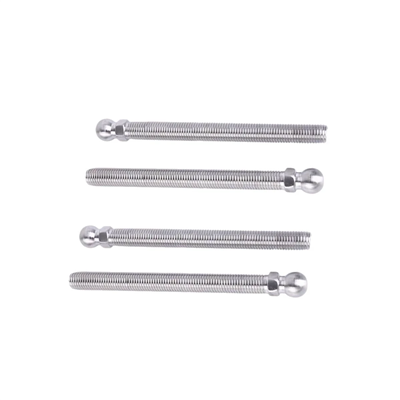
At the end of the day, the weight capacity of an inner ball joint is more than just a number on a spec sheet. It’s a reflection of the materials, the design, and the manufacturing quality that goes into that small, essential part. Whether you’re working on a compact car, a heavy-duty truck, or anything in between, choosing the right inner ball joint for the job isn’t just about getting a part that fits—it’s about getting a part that will keep you safe and save you money in the long run. If you’re looking for high-quality inner ball joints that meet strict weight capacity standards, or you have questions about which joint is right for your vehicle, don’t hesitate to reach out to our team for a consultation. We’re here to help you make the right choice for your repair or project, no matter the size.
Stainless Steel Ball Joint References
Automotive Ball Joint Load Ratings: A Guide for Service Technicians. Automotive Service Association, 2021.
Material Science for Automotive Suspension Components. Society of Automotive Engineers (SAE), 2019.
Dynamic Load Testing of Steering and Suspension Parts. National Highway Traffic Safety Administration (NHTSA), 2020.
Taizhou Huazhe Auto Parts Co., Ltd.
As one of the most professional inner ball joint manufacturers and suppliers in China, we’re featured by quality products and low price. Please rest assured to buy bulk high-grade inner ball joint in stock here from our factory. For pricelist, contact us now.
Address: No. 2828, Binkang Avenue, Sanjia Street, Taizhou Bay New Area, Taizhou City, Zhejiang Province
E-mail: 19906762800@163.com
WebSite: https://www.huazheindustry.com/
